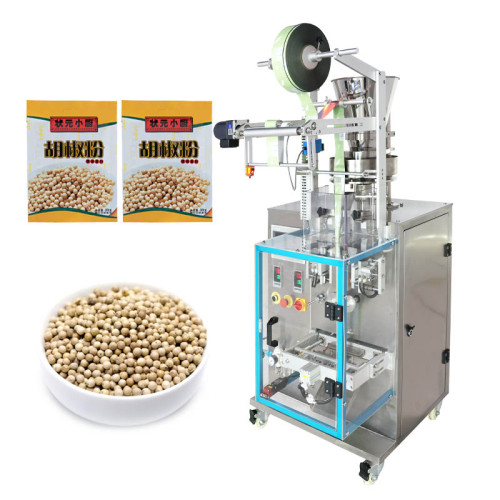
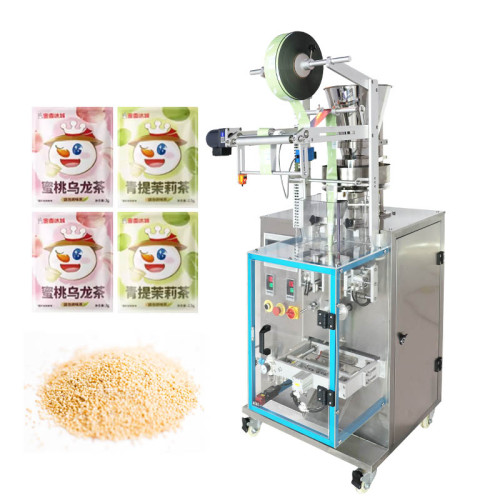
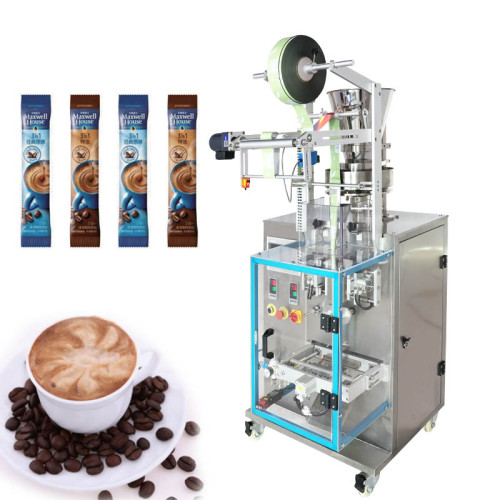
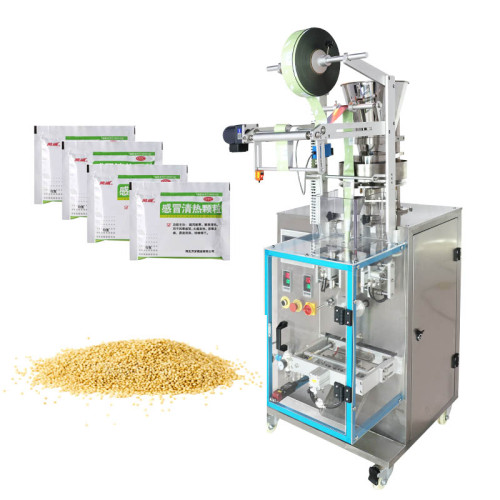
Granule Filling Machine Manufacturer
- Model
- FM012
Item specifics
- Packaging products
- granule
- Filling specification
- 30-1000ML
- Hopper size
- 150L(304 stainless steel )
- Machine power
- 6Kw
Review
Description
Introduction of Granule Filling Machine Manufacturer
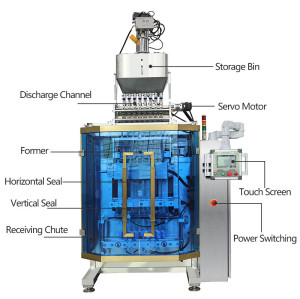
Granule filling/packaging machines are highly automated and widely used equipment. Their core components can be divided into several major systems that work together to complete the entire process from metering, bag making, filling to sealing and output.
The following is a detailed explanation of the core components of a granule filling machine:
I. Metering and Filling System
This is the key component determining packaging accuracy and speed.
Metering Devices:
Screw Metering Machine: Most commonly used for powders and fine granules. Metering is achieved by controlling the number of rotations of a precision screw; high accuracy and adjustable.
Volume Metering Cup (Feeding Hopper of a Combination Scale): Used for free-flowing granules (such as seeds and nuts).
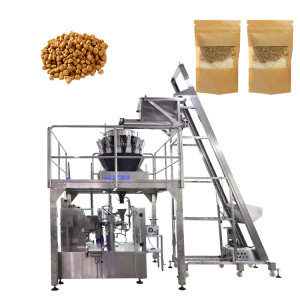
Multi-Hopper Combination Scale: The golden core of medium- and high-speed packaging machines. Composed of multiple independent metering hoppers, the computer uses algorithms to combine the weights from multiple hoppers, quickly selecting the combination closest to the target weight. Extremely fast and highly accurate, it is a hallmark of high-end granule packaging machines.
Weighing Scale: Directly used for high-precision or large-scale quantitative measurement, such as embedded electronic scales.
Filling Mechanism: Connected to the metering device, it accurately guides material into the formed bags via chutes, funnels, etc.
Bag Making and Forming System: Responsible for shaping the roll film into the desired bag shape.
Film Frame and Tension System: Supports the roll film and maintains constant and stable tension during unfolding, ensuring pattern alignment and bag flatness.
Forming Unit: One of the core components. It is a fixed-shape metal mold (e.g., "elephant trunk" or "lapel") through which the flat film is folded into a preset shape (e.g., back-seal bag, three-side seal bag, four-side seal bag).
Film Pulling Mechanism: Typically driven by servo motors, this clamping mechanism or friction wheel precisely pulls the film downwards to a set length.
III. Heat Sealing and Cutting System
Completes the sealing and separation of the bags.
Longitudinal Sealing Device: Performs continuous heat-sealing on the longitudinal seams of the film.
Transverse Sealing Device: Crucially important. Seals the top and bottom ends of the bag after filling. It simultaneously performs:
Top horizontal sealing: Seals the bottom of the previous bag and the top (below the cut) of the current bag.
Bottom horizontal sealing/cutting: Seals the bottom of the current bag and separates the finished bag from the film using a built-in cutter.
The horizontal sealer typically consists of a heating block, a cooling block, and a high-temperature resistant sealing strip to ensure a strong and aesthetically pleasing seal.
Cutter: Integrated into the horizontal sealer, it offers various cutting methods including hot cutting, cold cutting, and serrated cutting.
IV. Power and Transmission Control System The machine's "brain" and "neuromuscles."
Servo drive system: The core power source of modern packaging machines. The main servo controls film pulling, the horizontal sealing servo controls sealing and cutting actions, and the filling servo controls material feeding, etc. The quantity and quality of the servo system directly determine the machine's speed, precision, and coordination.
Programmable Logic Controller (PLC): The control center. Receives signals from various sensors and coordinates the sequence and timing of actions of all motors, cylinders, and heaters.
Human-Machine Interface (HMI): A touchscreen used to set parameters (bag length, speed, temperature, etc.), monitor operating status, and output data.
Sensors: Including photoelectric marker sensors (identifying cursors on the film to locate patterns), proximity switches, temperature sensors, etc., providing real-time feedback to the PLC.
V. Auxiliary and Peripheral Systems
Date Printing System: Such as a thermal stamping machine or inkjet printer, used to print the production date and batch number on the bag.
Checkweigher (Optional): Located at the output end, automatically rejecting products that do not meet the weight requirements.
Exhaust System: For easily dusty fine particles, there may be an air suction device to extract air from the bag opening before sealing, reducing dust contamination of the sealing area.
Frame and Protection: Sturdy machine body and stainless steel protective cover.