The Secrets of Pharmaceutical Blister Packaging
- Share
- Issue Time
- Nov 23,2025
Summary
Blister packaging is portable, helps patients adhere to dosing regimens, and protects drug quality over a longer shelf life.
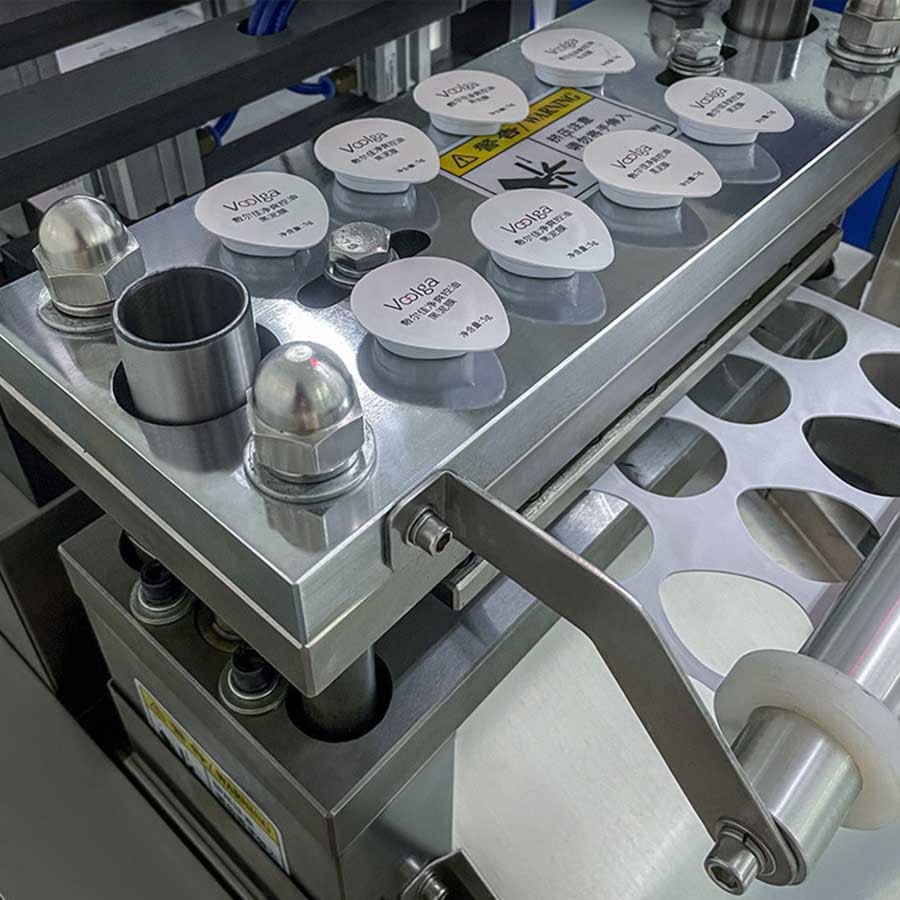
Blister packaging is portable, helps patients adhere to dosing regimens, and protects drug quality over a longer shelf life. Advocates cite several advantages of blister packaging over traditional packaging, including product integrity, ease of production, tamper-proofing, reduced risk of accidental misuse, and better patient compliance. Having already discussed the materials used in blister packaging and the typical structure of a blister pack, this article will introduce blister packaging machinery and assembly, as well as the cost of blister packaging and discuss future trends.
Blister Packaging Machinery Modern thermoforming-filling-heat-sealing blister packaging machines can operate at speeds not exceeding 800 cycles/min. Today, a key focus for improving production efficiency is the application of microprocessor control, connecting the filling and forming equipment to downstream equipment such as cartoning and wrapping machines via electronic connections. The filler also fills tablets or liquid medication into individual blister cells, ensuring accurate dosing. Modern machinery also uses integrated vision systems to help ensure the accuracy of blister filling and product integrity. These machines have become quite versatile, easily adaptable to several different types of sealing foil and composite sheets, enabling manufacturers to achieve better compatibility between pharmaceuticals and packaging materials, and better patient compliance.
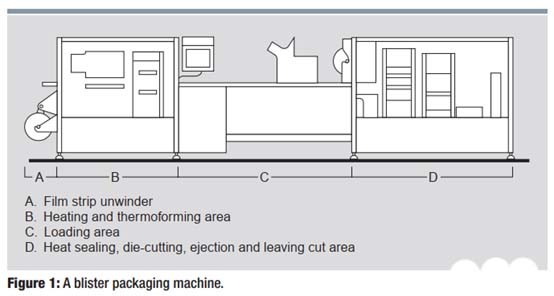
Blister packaging offers numerous advantages to the pharmaceutical industry and the public, and packaging equipment will continue to support this proven form of packaging. Improvements in forming methods, packaging materials, and blister packaging machinery will continue to enhance the suitability of drug delivery formats and pharmaceutical distribution. Figure 1 illustrates an example of blister packaging equipment.
Standard Assembly Process for Blister Packaging Machines
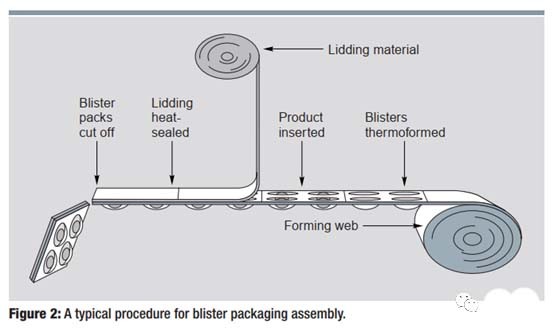
The standard assembly process includes: heating the plastic sheet, thermoforming the blister pack, filling the tablets, covering with sealing foil, and heat sealing. This can be a simple manual process or a semi-automatic or fully automatic process. While it is possible to purchase empty, pre-formed blister packs and sealing foil and then fill the medication separately, this is not common. Instead, it is more prevalent for blister packaging to complete both forming and filling in one machine (see Figure 2).
Assembly Details
Blister packaging machines are typically intermittent in operation. The sealing operation is completed within the dwell time required for thermoforming. The basic components and functions of an intermittent packaging machine include the following:
**Shelf Station:** The shelf station provides the unwinding speed of the forming rigid sheet and sealing foil, adapted to the operating speed of the
blister packaging machine (see Figure 1, Part A).
**Heating Station:** The heating station raises the temperature of the plastic forming rigid sheet to a suitable level for stretching. PVC rigid sheets can be heated to 120-140°C, and PP rigid sheets to 140-150°C. Composite aluminum foil does not require heating before forming (see Figure 1, Part B).
**Forming Station:** The forming station shapes the bubble openings using compressed air or a template. Composite aluminum foil only uses mechanical forming dies to punch out the bubble openings (see Figure 1, Part B).
**Cooling Station:** PP rigid sheets require cooling after forming; PVC rigid sheets or composite aluminum foil do not require cooling after forming.
**Filling Station:** The product is filled into the bubble openings. The filler can be linked or simply sweep the product to be packaged into the blister pack (see Figure 1, Section C).
Sealing Station: The sealing station seals the sealing foil onto the molded rigid sheet containing the medicine (see Figure 1, Section D). All heat sealing methods involve pairing the sealing foil and rigid sheet under constant pressure for a specified heating time period. When heating stops, the fusion surfaces fuse and bond almost instantaneously. Sealing temperatures typically range from 140 to 340°C, depending on the machine type.
Cooling Station: All rigid sheet molding requires cooling at the cooling station (see Figure 1, Section D). Polypropylene rigid sheet molding must be cooled for a longer time than other rigid sheets.
Packaging and Labeling: After packaging, labels are affixed, and batch numbers are printed. An embossing device creates cross-shaped embossing at the blister seal seams. The blister pack is then cut into several slabs at the die-cutting station, each typically containing 10 to 20 blister packs. A vision system inspects the filled blister packs for defects, and finally, the multi-functional packaging machine boxes and cartons them.
Blister Packaging Costs
Pharmaceutical packaging has a significant impact on profitability, accounting for approximately 10% of the cost of prescription drugs and as much as 50% of the cost of over-the-counter drugs. Therefore, sales can be positively or negatively affected by packaging, especially for OTC products.
Cost Comparison
The costs of various pharmaceutical packaging are rarely published. However, a cost study reports that blister packaging for unit doses of oral medications is cost-competitive with bottle packaging. The report compared 60cm³ and 125cm³ bottles and five types of blister packs, with doses ranging from 7 to 100 units, and six blister pack structures (child-protected and non-child-protected PVC, PVDC/PVC, PVC/Aclar). The researchers also considered the cost of each component, including:
■ Packaging line operation (e.g., equipment, speed, efficiency, and labor)
■ Shipping
■ Freight
■ Distribution
■ Pharmacy inventory and dispensing
The study found that when considering total system costs (including repackaging of medications and pharmacist time costs), blister packaging represents a significant cost saving compared to traditional bottles. For example, compared to bottle packaging, a PVC blister pack with child protection can save $4.58 per 100 doses. From a production perspective, bottle packaging is generally more cost-effective than blister packaging, except for the most compact blister pack and the simplest blister structure. Table 1 lists the cost comparisons from the research report.
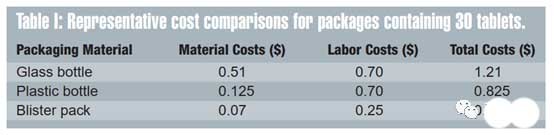
In this case, even if material costs double, blister packaging design remains advantageous because the blister pack only accounts for a portion of the material cost; the remainder is the sealing foil, resulting in a total cost of $0.32 per packaging unit. Compared to plastic or glass bottles, savings in labor costs are an advantage of flexible packaging like blister packs due to their higher degree of automation. Furthermore, blister packaging is more economical to produce because it is fully automated and requires minimal human support.
Breakpoint
For certain product quantities, blister packaging offers no advantage, and bottle packaging is more cost-effective. Generally, the break-even point is around 100 dosage units. For tablet sales volumes under 100 tablets, the most economical packaging is blister packaging, i.e., 10 tablets/blister pack or 10 blisters. For larger pharmaceutical distribution volumes, bottle packaging is the most economical option. Therefore, this research report indicates that blister packaging is more cost-effective for 50-100 dosage units, and more expensive for volumes exceeding 100 dosage units.
Future Trends in Blister Packaging
Unit-dose packaging is a major trend in pharmaceutical packaging and has a significant impact on the development of blister packaging. In addition, two major factors will have a significant impact on the development of blister packaging in the United States: clinical trials and regulatory developments.
Clinical Trials
As clinical trials increase, many product formulations are becoming more complex, and more and more pharmaceutical companies are starting to use blister packaging. From the perspective of convenience and patient compliance, using blister packaging in clinical trials is beneficial. For example, in a dose-range study, patients need to take four tablets (or a placebo) daily, and the simplest packaging method is blister packaging. For patients, taking one tablet from one bottle and then another, etc., is inconvenient. With blister packaging, all the medications are in one place, making them easy to label and distinguish.
New Regulations
Two regulatory regimes related to iron supplements and methamphetamine manufacturing will also affect the future development of blister packaging.
Iron Supplements
The FDA's final regulation, titled "Iron Supplements and Drugs: Labeling Warning Statements and Unit-Dose Packaging Requirements," took effect on July 15, 1997. One provision called for iron-containing products packaged in blister packs to contain at least 30 mg of iron per unit dose. Some companies were forced to remove iron-containing products from shelves because they were not packaged in unit doses. Therefore, to comply with regulations, these companies will have to use blister packs.
Methamphetamine Manufacturing
On October 3, 1996, President Clinton signed the Comprehensive Methamphetamine Control Act. This act expanded regulations on certain chemicals used in the production of methamphetamine, increased penalties for trafficking and manufacturing methamphetamine and listed chemicals, and broadened the scope of regulation to include the sale of certain legally sold products containing ephedrine, pseudoephedrine (PSE), and phenylpropanolamine (PPA). Transactions involving PSE and PPA must be registered, recorded, and reported in accordance with the Controlled Substances Act.
However, the Act provides a safe harbor exemption for over-the-counter drugs containing PSE and PPA to be sold as ordinary commodities. For a product to be included in the safe harbor, it must meet the following two requirements:
■ The packaging must contain no more than 3g of the essential ingredients.
■ The product must be packaged in blister packs, with no more than two tablets per blister pack (unless blister packs are technically impossible, such as for liquid preparations).
Since October 3, 1997, any drug not packaged according to the safe harbor exemption requirements, if sold in a single transaction exceeding 24g, must be registered with the Drug Administration, and the transaction record must be kept. In other words, to avoid the registration and filing work involved, retailers should sell certain over-the-counter drugs containing PSE and PPA in blister packs. The purpose of the Act is to prevent the rampant use of these substances to manufacture illicit drugs, making it more difficult to open each blister pack to obtain the required quantity of medication.
Conclusion: The demand for drug packaging is increasing and will continue as pharmaceutical companies become increasingly reliant on packaging to protect and promote their products in a highly competitive and rapidly changing pharmaceutical market. While healthcare practitioners typically select drugs, drug manufacturers must consider the user when designing packaging. Just as appearance and ease of use are important for consumer products, they are also key to the success of a drug. Furthermore, for over-the-counter drugs and nutritional supplements, consumer appeal is paramount.
Companies adopting blister packaging will undoubtedly face both challenges and opportunities. The Consumer Product Safety Commission has asked packaging engineers to develop creative solutions that meet its requirements for child protection and high friendliness. With additional regulatory regimes such as ICH testing guidelines and US FDA regulations on iron supplements, a significant increase in the use of blister packaging and the application of innovative materials is expected.