What are the advantages and disadvantages of the multi-lane liquid packaging machine?
- Share
- Issue Time
- Nov 2,2025
Summary
The advantages and disadvantages of multi-lane liquid packaging machines can be analyzed in depth from multiple perspectives, including equipment performance,
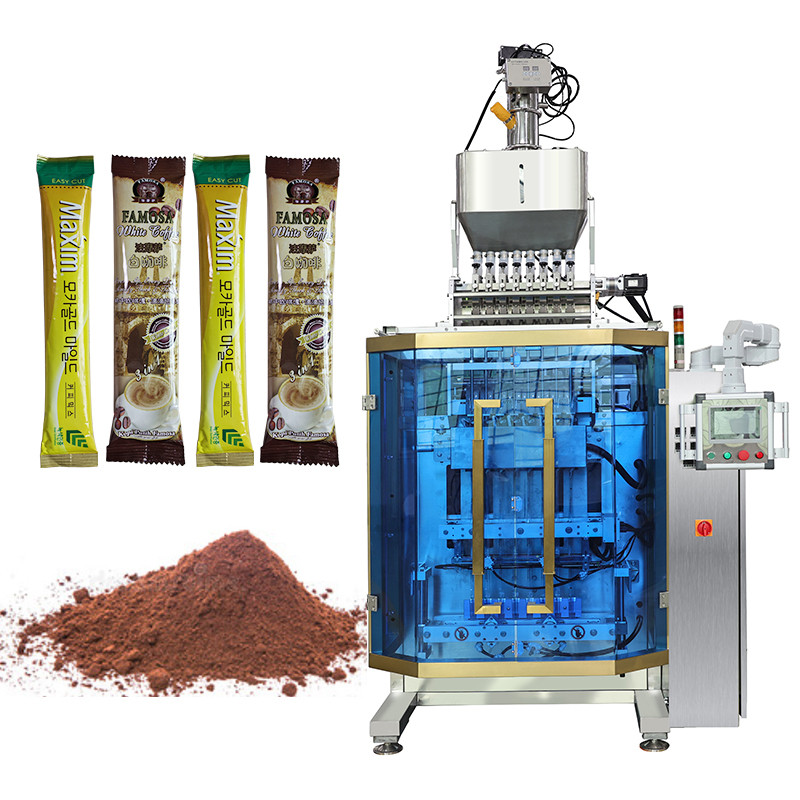
The advantages and disadvantages of multi-lane liquid packaging machines can be analyzed in depth from multiple perspectives, including equipment performance, production efficiency, cost-effectiveness, and applicability.
A multi-lane liquid packaging machine, as the name suggests, features multiple (e.g., 4, 6, 8, or even more) independent metering and filling systems installed side by side on the crossbar of a single main machine. These systems share a common drive, control system, and film roll, producing multiple bags of product simultaneously. It is essentially a highly integrated system of multiple single-lane packaging machines.
Advantages of Multi-lane Liquid Packaging Machines
1. Extremely High Production Efficiency
Core Advantage: This is the most prominent advantage of multi-lane machines. For example, the theoretical speed of an 8-lane packaging machine is 8 times that of a single-lane machine. For high-volume, standardized product production (such as water, soy sauce, vinegar, beverages, and dairy products), it can significantly shorten production cycles and meet the huge market demand.
2. Significantly Reduced Unit Costs
High Per Capita Output: A multi-lane machine requires only one or two operators, yet produces the same output as a production line consisting of multiple single-lane machines and multiple operators. This significantly reduces labor costs.
Small Footprint: Compared to a combination of multiple single-lane machines achieving the same output, a single multi-lane machine occupies a significantly smaller footprint, saving valuable factory space.
Concentrated Energy and Consumables: A single main drive and control system drives multiple lanes, resulting in lower total energy consumption than multiple single machines. Furthermore, a single roll of wide packaging film offers greater cost advantages in procurement and management than multiple rolls of narrower film.
3. Excellent Production Consistency and Easier Management
All lanes share a common core control system and film rolls, ensuring high uniformity in bag shape, length, date, and other visual markings.
Maintenance, maintenance, and parameter settings are required for a single unit, making management far less complex than managing a production line comprised of multiple single machines.
4. High Level of Automation and Intelligence
Multi-lane machines are often part of automated production lines, making them easier to seamlessly integrate with upstream mixing and blending systems and downstream cartoning, boxing, and palletizing robots, achieving fully automated production from raw materials to finished product.
Disadvantages of Multi-lane Liquid Packaging Machines
1. Poor flexibility and complex production changeovers.
Core Disadvantage: This is the primary drawback of multi-lane machines. Changing product specifications (such as changing bag width or length) requires replacing components such as formers and filling nozzles in all rows, resulting in extensive and time-consuming adjustments.
Unsuitable for small-batch production of multiple categories: If a factory frequently switches between different product categories and specifications, the efficiency advantages of a multi-row machine are significantly reduced, and may even become a bottleneck.
2. High Initial Investment Cost
A multi-row machine costs significantly more than a single-row machine. While its unit cost is lower, the high initial investment places a significant financial burden on small and medium-sized businesses.
3. Risk of "One Failure, All Losses"
If the main drive or core control system of the main machine fails, the entire line will be shut down, resulting in significant losses. However, if one single-row machine fails, the others can continue production.
Although each row has an independent metering system, the close physical arrangement means that a mechanical failure in a single row (such as a bag jam) can affect the normal operation of adjacent rows, and maintenance space is relatively limited.
4. High consistency requirements for materials and packaging materials
Material properties such as viscosity and flowability must be extremely stable; otherwise, the filling accuracy consistency across all rows will be affected.
Extremely high quality requirements are placed on the packaging film. Issues with film thickness uniformity, printing quality, and tension will affect product quality across all rows.
5. Technically complex and requiring high personnel skills
The equipment's mechanical structure, electrical control, and software systems are significantly more complex than those of single-row machines, requiring a higher level of skill from operators and maintenance technicians. Improper operation or commissioning can result in large-scale scrap.
Summary and Comparison of Applicable Scenarios
| Multi-lane Liquid Packaging Machine | Single-lane Liquid Packaging Machine | |
| Features | High speed, high efficiency, low unit cost | High flexibility, low initial investment, low risk |
| Core Advantages | Extremely high, suitable for large-scale continuous production | Relatively low, suitable for small-scale or pilot production |
| Production efficiency | Poor, slow and cumbersome production changeover | Good, fast and easy production changeover |
Initial Investment | High | Low |
Risk | "One failure leads to a loss for all," resulting in significant production downtime losses | A single machine failure does not affect others, distributing risk |
Footprint | Small (compared to a fleet of single machines with the same output) | Large (requires multiple machines to achieve the same output) |
Management Complexity | Low (only one machine to manage) | High (requires managing a production line) |
Conclusion:
Choose a multi-lane liquid packaging machine: If your product category is narrow, specifications are stable, and market demand is high, and you're seeking economies of scale and the lowest unit production cost, then a multi-lane machine is the perfect choice. These machines are commonly found in large drinking water plants, condiment giants, and dairy groups.
Choose a single-lane liquid packaging machine (or a combination of multiple machines): If you have a diverse product range, require frequent production changeovers, have small order batches, or are in the market development phase with a limited initial budget, a single-lane machine or flexible production line is a wiser choice. These are commonly used in small and medium-sized food factories, new beverage production lines, and contract manufacturing plants.
When choosing a single-lane liquid packaging machine, companies must make a comprehensive assessment based on their product strategy, market size, budget, and production model.