The Secrets of Blister Packaging for Medicines (Part 1)
- Share
- Issue Time
- Nov 23,2025
Summary
In Europe, 85% of solid medications use blister packaging, compared to less than 20% in the United States. However, as manufacturers and consumers become increasingly aware of the benefits
In Europe, 85% of solid medications use blister packaging, compared to less than 20% in the United States. However, as manufacturers and consumers become increasingly aware of the benefits of blister packaging, its acceptance in the US is growing. This article will briefly introduce blister packaging materials and typical blister structures.
Packaging is one of the largest components of global industry, valued at $280 billion. Consumer healthcare packaging accounts for 4% ($11.2 billion). As pharmaceutical manufacturers enter the 21st century, they face numerous challenges, and packaging can help them meet some of these needs.
Ten years ago, many pharmaceutical companies often neglected packaging, viewing it merely as the final step in production. Now, however, pharmaceutical companies must consider packaging much earlier in the development process. Pharmaceutical packaging is rapidly becoming an essential part of the drug delivery system and a core element of the marketing mix, allowing manufacturers to differentiate their products from competitors. The demand for pharmaceutical packaging is increasing and will continue to increase as pharmaceutical companies rely more heavily on packaging and labeling as a medium to protect and promote their products, improve patient adherence, and comply with new regulations.
Basic Configuration of Blister Packaging
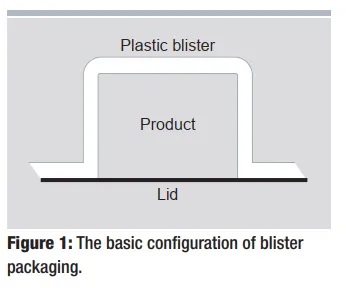
Background There are two basic types of pharmaceutical blister packaging. One type has a cavity made of transparent, thermoformed plastic, with a covering made of transparent plastic or a composite of plastic, paper, and/or foil. The other type contains two types of foil, both essential components of the blister pack, and its cavity is created by cold stretching. Figure 1 shows the basic configuration of blister packaging.
In the early 1960s, Karl Klein designed the first stamping blister packaging machine. He did not obtain a patent for this design because the European pharmaceutical industry was not interested until a few years later when the contraceptive pill was introduced. Schering (Berlin, Germany) chose blister packaging for this revolutionary medicine because it seemed to be the most suitable packaging method to ensure effective dosing.
Therefore, the most important reason for introducing blister packaging technology was to provide patients with clearly marked personal doses, allowing them to check whether they had taken the prescribed medication on a particular day. Furthermore, any unremoved medication remained in its original packaging and was adequately protected from adverse external conditions. Compared to traditional packaging forms, blister packs were easier for patients to handle and could be stored more conveniently.
Soon, manufacturers and packers recognized other advantages of blister packaging, such as protection against glass breakage, lower cost compared to other packaging materials, and higher packaging speed. Another important benefit later became apparent: blister packaging made it easier to prove misuse compared to traditional packaging. Therefore, blister packaging effectively met the need for tamper-evident packaging. All these advantages explain why approximately 85% of solid medications in Europe use blister packaging.
A Comparison of Applications in Europe and America
The situation is quite the opposite. In the United States, almost all over-the-counter and prescription drugs are packaged in bottles. For example, currently less than 20% of non-liquid medications are sold in blister packs in the US.
There are many speculations about the reasons for the significant differences in the use of blister packs between Europe and the US. First, after World War II, packaging machinery in Europe (like almost everything else) was destroyed. European pharmaceutical packers started from scratch, choosing blister packaging machinery over bottle-filling equipment. Second, regulations on child-safe caps are far less stringent in Europe than in the US. A third reason is the difference in healthcare plans between the two regions. In Europe, most healthcare plans limit the number of units in a single prescription to 10 to 14 days. However, in the US, insurance companies allow for longer supply periods, typically 30 to 60 days. European purchases are smaller, making blister packs more suitable because packaging smaller quantities is less expensive than using bottles. Finally, the European Community has stronger environmental incentives to promote the use of blister packs. For example, manufacturers are penalized for introducing excessive material into the system. Using blister packs allows manufacturers to reduce packaging to a minimum size.
Increased U.S. Use
Blister packaging is gaining increasing acceptance in the United States as pharmaceutical manufacturers and consumers recognize its benefits. Blister packaging helps patients adhere to medication regimens, protects medications for longer shelf life, and is convenient to carry. Advocates for blister packaging in the U.S. cite five advantages over conventional packaging:
Product Integrity
Product Protection
Tamper-evident
Reduced Risk of Accidental Dosing
Patient Adherence
Product Integrity
In the U.S., the preparation of prescription drugs at the retail level is fraught with uncertainty. Pharmacists or pharmaceutical technicians count pills in the uncontrolled atmosphere of supermarkets and pharmacies, where sensitive medications are transferred from one container to another, and many factors can negatively impact their quality.
Blister packaging helps maintain product integrity because medications pre-packaged in blister packs are shielded from adverse conditions. Furthermore, the possibility of product contamination is minimized, and each dose is labeled with the product name, batch number, and expiration date. Therefore, blister packaging ensures product integrity from manufacturer directly to consumer through distribution.
Product Protection
Blister packaging provides better protection for medications at home than bottle packaging. For example, most consumers store medications in a medicine cabinet in the bathroom, but the bathroom environment is periodically filled with steam. As a result, it's no exaggeration to say that once a bottle is opened in such an environment, any unused medication will no longer be the same as before. In contrast, blister packaging seals tablets or capsules within their own blister. Unused medication remains in its original packaging and is fully protected from external conditions. The blister protects moisturizing tablets before administration. In contrast, the moisture in the top space of multi-unit bottle packaging is replaced each time the bottle is opened.
Explicit Tamper-evident Technology
Explicit tamper-evident technology is another advantage of blister packaging. Each dose is individually sealed in a blister made of plastic, foil, or paper. This packaging design ensures that the patient must tear open the blister to access the medication, making it impossible to separate the blister and medication without leaving evidence. Once the bottle is opened, any explicit tamper-evident mechanism will be lost. However, with blister packaging, each tablet or capsule is individually protected before use and cannot be tampered with; any form of tampering can be detected immediately.
Reducing the likelihood of accidental ingestion
Blister packaging can also be child-protective, and several such designs are currently in use. Most child-protective blister packs contain a peelable adhesive layer with a paper/film layer. Patients must peel the adhesive from the back of the foil before they can push the tablet out. Designated 15mm polyvinyl chloride (PVC) blister material provides additional safety because children are less likely to bite through it. Companies are also experimenting with bitter-tasting coatings to deter children from putting blister packs in their mouths.
Patient compliance
Finally, another added benefit of blister packaging is patient compliance. Up to 30% of all prescription drugs are not used correctly initially, and up to 50% are not continued after one year. This abuse can lead to a range of adverse drug reactions, including death.
The Healthcare Compliant Packaging Council (HCPC, Washington, D.C.), founded in 1990, is a nonprofit organization that educates consumers, professionals, and healthcare policymakers about the role of blister packaging in drug compliance. Here are some key findings from a recent HCPC study in the United States:
A total of 1.8 billion prescriptions are issued annually, half of which are incorrect.
10% of hospitalizations are due to medication misuse.
The economic losses from medication misuse are estimated at $13 billion to $15 billion annually.
23% of those admitted to nursing homes are elderly and unable to manage their medications at home.
An estimated 125,000 Americans die each year due to medication non-compliance.
The elderly population consumes approximately 50% of prescription drugs, exacerbating the problem of medication misuse.
Furthermore, blister packs in hospitals and nursing homes can be barcoded to prevent errors during medication dispensing. A final significant benefit of blister packs in terms of patient adherence is that pharmacists have more opportunities to communicate with and advise patients, requiring less time for dispensing.
The use of blister packs is on the rise in the United States. For example, several years ago, New York and New Jersey mandated that hospitals implement unit-dose blister pack dispensing systems. A report cited by the New Jersey Hospital Pharmacists Association indicates that such unit-dose blister packaging systems have only resulted in a few instances of medication errors. Logically, it seems likely that more states will adopt similar regulations.
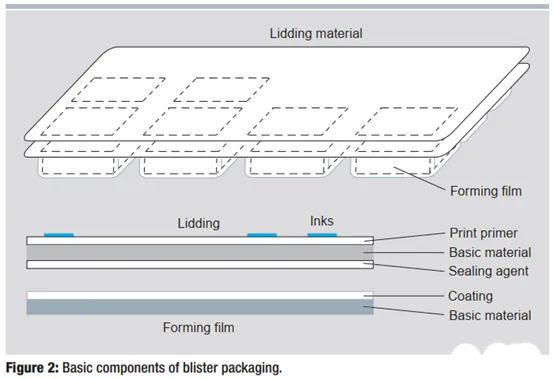
Blister Packaging Components Pharmaceutical blister packaging has four basic components: a rigid sheet, a cover foil, a heat-sealing coating, and ink printing (see Figure 2). The most common blister packaging in the United States consists of a foil, rigid sheet, paper, or composite material backed onto a thermoformed plastic blister pack. The rigid sheet accounts for approximately 80-85% of the blister pack's weight, and the cover film accounts for 15-20%. Because the rigid sheet and cover film form a single unit, they must be precisely matched.
Molded Rigid Sheets
Molded rigid sheets are packaging components that receive the product within stretched blister packs. A key to successful packaging is selecting the correct molded rigid sheet for the blister pack based on its properties, type, and thickness. The thickness and weight of the product, the sharp or pointed edges of the final package, and resistance to impact, aging, migration, and the cost of the rigid sheet must be considered. The plastic must also be compatible with the product. Factors affecting packaging production and assembly speed must be considered, including heat-sealing performance and the ease of punching and trimming the blister pack.
Features
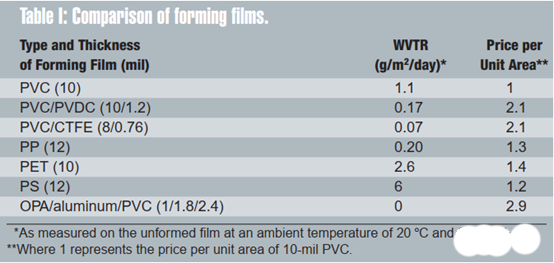
Molded rigid sheets, such as PVC, PP, and PET, can be thermoformed, but aluminum-containing support materials are cold-formed. Molded rigid sheets are typically colorless and transparent, but can also be used for light-blocking purposes, such as child protection packaging or protecting photosensitive medications. Molded mesh blister packs are almost always made of PVC, sometimes with coatings or additional materials to enhance oxygen and water vapor barriers. Table I compares the water vapor transmission rate (WVTR) and unit price of various molded rigid sheets.
Types of Molded Rigid Sheets
1. PVC (Polyvinyl Chloride)
PVC molded rigid sheets are called PVC rigid sheets because they contain almost no plasticizers. PVC rigid sheets are a very clear, rigid material with low water vapor permeability. It has excellent thermoplasticity, high flexural strength, good chemical resistance, low permeability to greases and flavorings, is easy to dye, and is low-cost. These properties make PVC rigid sheets the preferred material for blister packaging, essentially holding 100% of the plastic parts market. Thermoformed PVC rigid sheets are approximately 10 mm thick.
The use of PVC has also attracted much criticism because its combustion produces hydrochlorides, which, under adverse conditions, can produce highly toxic dioxins. Germany and Switzerland have legislated against the incineration of PVC, which is their primary response. This has led to a bias against using PP for blister packaging in Europe, and many pharmaceutical companies now stipulate that any new blister machines must be able to handle both PVC and PP.
2. PVDC/Coated PVC
Although PVDC has a small volume in pharmaceutical packaging, it plays a crucial role in the layered structure of blister packaging and the PVC coating. PVDC is the most common coating in blister packaging because it reduces the air and moisture permeability of PVC blister packaging by 5-10 times. Coated PVC rigid sheets are 8-10mm thick, while PVDC coatings are 1-2mm thick. The PVDC-coated side of the rigid sheet usually faces the product and sealing foil.
3. PVC/CTFE (Polychlorotrifluoroethylene)
PVC/CTFE composite rigid sheets have the lowest water vapor transmission rate of all types of rigid sheets. Compared to 10mm PVC rigid sheets, the water vapor transmission rate of an 8mm PVC and 0.76mm CTFE composite rigid sheet is 15 times lower. However, PVC/CTFE rigid sheets also pose environmental concerns.
4. PP (Polypropylene)
The use of PP as a support material in blister packaging is gradually increasing. Uncoated PP has a lower water vapor transmission rate than uncoated PVC, and is roughly equivalent to that of PVDC/PVC. The thickness of PP rigid sheets in the thermoforming process is 10-12mm.
PP's advantages include easy recyclability, no toxicity upon incineration, and good moisture barrier properties. PP has the potential to replace PVC, especially in Europe.
However, PP also has its disadvantages, one of which is thermoforming. Thermoforming PP requires precise temperature control and subsequent cooling. Blister sheets need to be straightened before packaging to prevent warping. Other challenges with PP include thermal instability, higher hardness than PVC, and sensitivity to shrinkage during subsequent processing.
Furthermore, PP is difficult to run on a standard blister packing machine, and its processing speed is far slower than PVC. If a company needs to use PP and new equipment, it must undergo precise process validation and perform various tests to meet FDA requirements. As a result, PP blister packs are practically non-existent in the US and have only limited application in Europe.
5. PET (Polyester)
PET is another potential alternative to PVC, but its higher moisture permeability prevents its widespread adoption. PET-coated PVDC can achieve the same moisture barrier properties as PVC, but this seems unlikely given the larger goal of replacing chlorinated plastics with PET.
6. PS (Polystyrene)
PS has perfect thermoplastic compatibility, but its high moisture permeability makes it unsuitable for blister packaging.
7. OPA/Al/PVC (Polyamide/Aluminum/PVC) or Nylon/Al/PVC (Nylon/Aluminum/PVC)
OPA/Al/PVC composite rigid sheets are interesting. A composite material consisting of 1mm OPA, 1.8mm aluminum foil, and 2.4mm PVC can almost completely block moisture permeation. Furthermore, due to the high proportion of aluminum foil, this material is easy to recycle (especially since sealing foil almost always contains aluminum foil). In this type of rigid sheet, efforts are underway to replace PVC with PP to meet environmental requirements.
Like other aluminum foil-containing composites, OPA/Al/PVC is cold-formed, and its cost per square meter is comparable to other coated PVC. However, compared to thermoforming, cold forming requires more packaging material to package the same size sheets or capsules.
8. CTFE Homopolymer
Honeywell (Morristown, NJ) recently introduced a 3mm CTFE homopolymer transparent barrier sheet (Aclar UltRx 3000), which is easy to thermoform and exhibits high moisture barrier properties. This reflects the trend towards using materials with high barrier properties. The variety of Aclar products enables the widespread use of blister packaging because they can be thermoformed to form transparent or colored blister cavities, and the barrier properties they exhibit are close to those of near-perfect barrier foils.
Sealing Material (Cover Foil)
The sealing material, as the base or main structure of the final blister packaging, must be selected based on the product's size, shape, weight, and packaging form. Sealing foil thickness ranges from 0.36 to 0.76 mm, but 0.46–0.76 mm is the most common range. The surface of the sealing foil must be compatible with the heat-sealing process. An adhesive layer is added to the cover foil to enhance printability. Heat sealing and printability are important considerations in blister packaging, and the cover foil material must offer the best feasible compromise.
1. Features
Cover foil can be transparent plastic, but in pharmaceutical packaging, it is either flat, a 1mm printed foil (for push-through blister packs), or a paper/foil or paper/PET/foil composite (for child-proof push-through blister packs). The cover foil material must ensure that moisture permeability is at least as low as the molded film and must be suitable for appropriate packaging opening methods (e.g., push-through or peel-off). Figure 3 shows a cross-section of the peeled cover foil. Table II shows a comparison of the unit area cost of various cover foils.
2. Cover Foil Types
Duralumin is a widely used push-through cover foil in Europe. Duralumin foil is typically 0.8mm thick, but we strive to reduce its thickness to 0.6mm, which is beneficial for push-through foil.
Usually, only the printed side has a printed pattern, but occasionally the heat-sealable layer can also be printed. A double heat-sealable coating (heat-sealable underlayer and actual heat-sealable coating) has become the standard for cover foil.
The heat-sealable underlayer ensures optimal adhesion between the heat-sealable coating and the foil, and the heat-sealable coating can be matched with the molded film. If the heat-seal underlayer is colored, applying a heat-seal coating on top prevents the packaged product from coming into contact with the pigment. If additional printing is required on the sides of the heat-seal coating, the only option is to apply two layers. This technique is necessary because the printing ink must be positioned between the heat-seal underlayer and the actual heat-seal coating.
3. Soft Aluminum
1mm soft aluminum is frequently used as child-proof foil. With exceptions depending on the type of foil used, this soft aluminum is structurally equivalent to 0.8mm hard aluminum. The softness and thickness of this type of foil help prevent children from pushing pills out. This material also has a perforation along the sealed seam so it cannot peel off entirely from the formed film.
4. Paper/Aluminum
A composite material of paper and aluminum, with the paper weighing 40-50g/m². In Europe, the typical thickness of the aluminum foil is 0.28-0.48mm, but in the United States, it is typically 0.6-1mm. The reason for this difference is that in Europe, this type of foil is used to prevent children from pushing through packaging, so the aluminum foil must be relatively thin. In the US, this material is used as a release foil, and its relatively thick thickness facilitates peeling. Because it is printed on the side of the paper, a printing underlayer is not required. Almost everything previously discussed about heat-sealable coatings applies to the combination of paper and aluminum.
5. Paper/Polyester/Aluminum
The paper/polyester/aluminum cover material is often called a peel-through foil, and this material is primarily used in the US. The concept is to first peel the paper/polyester layer onto an aluminum foil layer, and then push the medicine out from the aluminum foil layer.
Heat-Sealable Coating
For blister packaging, the heat-sealable coating is perhaps the most critical component of the entire system. The appearance and physical integrity of the packaging depend on the quality of the heat-sealable coating.
The heat-sealable coating provides a bond between the plastic blister and the cover foil. These solvent-based or water-based coatings can be applied to roll paper or printed board using roller coaters, gravure or flexographic printing methods, or by applying a knife, screen, or spray. Regardless of the system, it is important that the appropriate coating weight is applied to the cover material for optimal heat-sealing results.
1. Features
Successful heat-sealable blister packs will exhibit good gloss, transparency, abrasion resistance, high heat-seal strength, and the ability to heat-seal various blister films. Heat seal strength is particularly important because the product is typically placed inside the blister pack and the cover material for heat sealing (face down). When the blister pops out of the heat-sealing mold, the still-warm adhesive line must support its entire weight. Relatively low heat-sealing temperatures are required for rapid sealing and to prevent heat deformation of the blister film.
While heat-sealing coatings used for blister packaging are still primarily solvent-based vinyl resins (due to their high gloss), water-based solvents are making some progress. However, their heat seal strength, gloss retention, adhesion to specific inks, and seal performance against the selected blister film must be carefully evaluated.
Furthermore, the heat-sealing coating must precisely match the cover material and the molded plastic material. Precise matching means that the preset sealing parameters must guarantee a permanent seal between the cover material and the molded film under any climatic conditions. The heat-sealing coating must also ensure a consistent heat seal effect under any given parameters. Specifically, the heat seal strength must be within predetermined tolerances and must be able to withstand push-through or peeling. The heat-sealing coating must also protect the printed area and provide a smooth printing surface. Most importantly, the heat-sealing coating must comply with FDA recommendations.
2. Printing Inks
Printing inks provide graphic and aesthetic appeal. They can be applied to cover foil using letterpress, gravure, offset, flexographic, or screen printing. Printing inks must withstand heat-sealing temperatures up to 300°C and must not exhibit any discoloration or stickiness (clogging). Furthermore, they must possess sufficient abrasion resistance, flexural strength, and colorfastness, and must be safe for use with the intended product. Printing inks should not contain excessive amounts of hydrocarbon lubricants, greases, oils, or mold release agents. Validation testing is always required before re-production. Finally, printing inks must comply with FDA recommendations.
3. Cold-Formed Foil
For Americans, the most well-known blister packs consist of aluminum foil, film, paper, or composite material backed onto a thermoformed plastic bubble. However, a less common type of blister pack is the foil/foil layer used for products particularly susceptible to moisture and/or light. Unlike all-plastic bubbles, these bubbles are not thermoformed but cold-formed. Products requiring the highest level of protection are packaged in full foil. The use of cold-formable foil is increasing due to the growing number of moisture-sensitive pharmaceuticals on the market. Cold-formable aluminum foil is favored because it is the only material that can 100% block moisture, oxygen, and light. This helps expand the applications of blister packaging, allowing sensitive products to be packaged in blister packs.
4. Features
One element of aluminum foil/aluminum foil blister packaging consists of a stack of plastic films (PVC or PE), adhesive, foil, adhesive, and an outer plastic film. The outer plastic film, which can be PET or PVC, supports the thin aluminum foil and acts as a heat-sealing layer. The aluminum layers typically consist of several very thin layers, rather than a single thick layer. Multiple layers help ensure that pinholes cannot penetrate the aluminum foil. They also increase the metal's tensile strength, facilitating the cold-drawing process.
However, the brittleness of cold-formable aluminum means that aluminum foil/aluminum foil blister packs cannot be formed like plastic blister packs. These multi-layered sheets are formed, filled, and sealed on a machine that performs these functions sequentially, much like a thermoplastic-fill-seal machine, except that the blister pack is not heated before the forming step.
Process
In the cold-forming process, the aluminum foil is molded into a cavity by a die. Therefore, it is a slightly more expensive process than thermoforming, and its molds are also slightly more expensive. Upgrading is an option for many companies—most new machines can be converted to cold forming. One disadvantage is that the cavity must be larger in the cold forming process than in the thermoforming process, thus increasing the overall area of the packaging and allowing the product to move within the blister pack.