Granule Sugar and Salt Packing Machine: Improving Accuracy, Speed, and Packaging Quality
- Share
- Issue Time
- Sep 8,2026
Summary
Granule sugar and salt packing machines provide accurate, hygienic, and efficient packaging for granular products. With automated weighing, sealing, and quality control, they help food manufacturers reduce waste, improve production efficiency, and maintain consistent package quality.
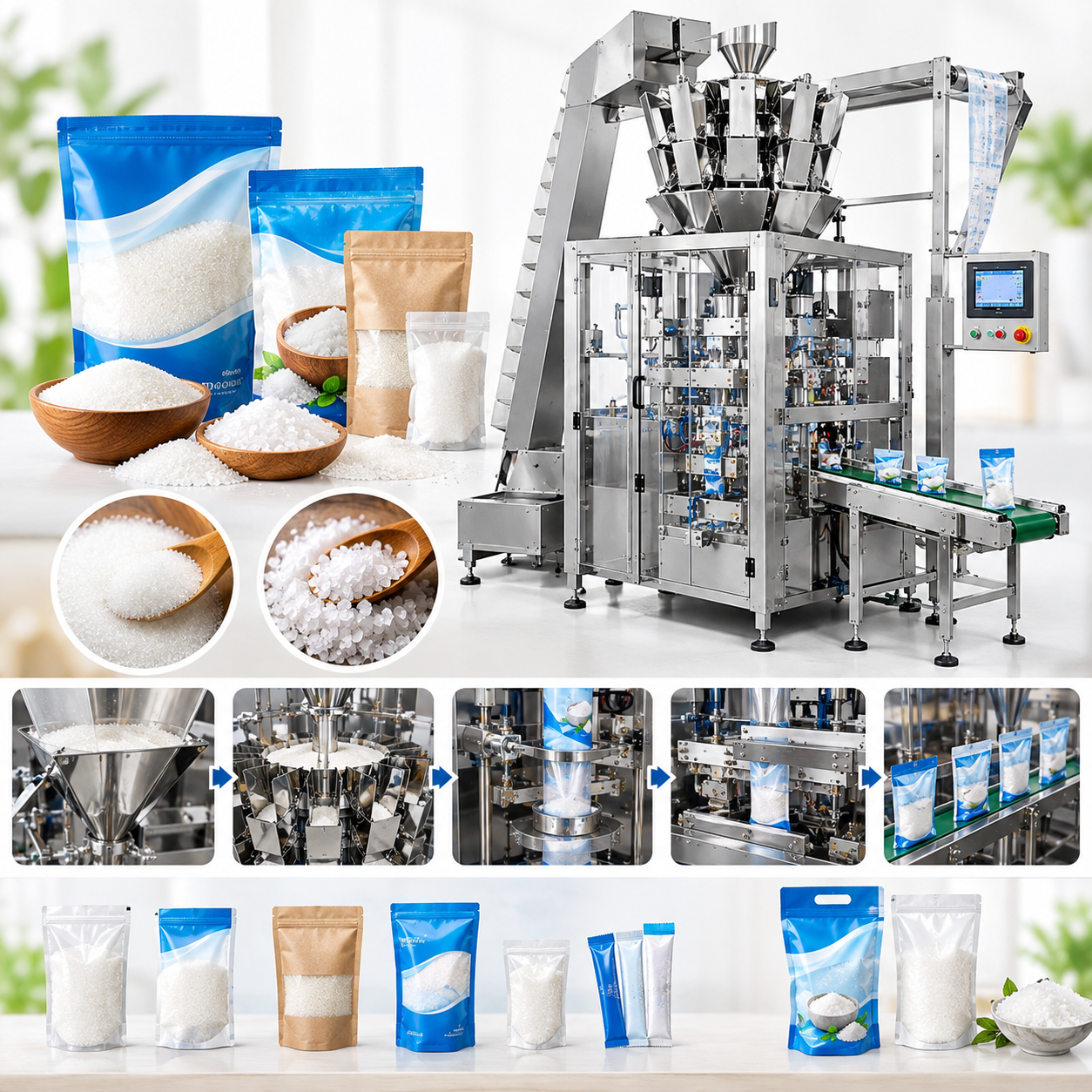
Granular sugar and salt are among the most widely packaged food ingredients, but their physical characteristics create specific challenges for automated packaging. A reliable granule sugar salt packing machine must provide stable product feeding, accurate portion control, dependable sealing, and continuous operation. For food manufacturers, the right packaging system can reduce material loss, improve labor efficiency, and maintain consistent package quality across large production volumes.
Modern granule packaging equipment combines weighing technology, automated bag forming, sealing, and intelligent controls to create an integrated solution for retail and industrial applications.
Understanding Granule Sugar and Salt Packaging Equipment
A granule sugar salt packing machine is designed to automatically measure and package free-flowing products such as granulated sugar, table salt, coarse salt, and similar dry materials. Different products may have variations in particle size, density, and flow characteristics, so the filling method should be selected according to the material being handled.
For coarse and irregular granules, multi-head weighing systems can provide accurate portion measurement by combining several weighed quantities before discharge. For finer materials, volumetric or screw-based filling systems may also be suitable.
A typical automated line can include a product hopper, feeding mechanism, weighing system, bag-forming unit, sealing jaws, cutting mechanism, conveyor, and PLC control system. Additional equipment such as checkweighers, metal detectors, date coders, and automatic rejection devices can be integrated according to production requirements.
How Does a Granule Packing Machine Work?
The packaging process begins when sugar or salt is transferred from the storage hopper toward the dosing system. The filling unit measures the required quantity and releases the product into a formed pouch or premade bag.
For roll-film packaging systems, the film is continuously unwound and shaped into a bag around a forming tube. After filling, the sealing mechanism closes the package and the cutting unit separates the finished bag.
Main Packaging Stages
● Product feeding: Granules are supplied continuously from the hopper.
● Quantity measurement: The weighing or volumetric system determines the target amount.
●Bag formation: Packaging film is shaped into the selected bag format.
● Product discharge: The measured sugar or salt enters the package.
● Heat sealing: The package is securely closed to protect the contents.
● Cutting and discharge: Finished bags are separated and transferred to the next stage.
Precise synchronization between these operations helps maintain stable production speed and package consistency.
Filling Technology for Sugar and Salt
The filling method has a direct influence on packaging accuracy. Multi-head scales are commonly considered for products with relatively good flowability and varying particle sizes. Multiple weighing hoppers allow the control system to select suitable combinations close to the target weight.
For finer granular materials, volumetric systems can provide a practical solution where the product has relatively stable bulk density. The appropriate technology should be determined through product testing rather than machine speed alone.
For B2B buyers, important parameters include target filling weight, acceptable weight tolerance, particle size, moisture level, bulk density, and required output.
Packaging Formats and Applications
Granular sugar and salt can be supplied through different market channels, making packaging flexibility important for manufacturers.
Retail Sugar and Salt
Supermarkets and grocery stores commonly require smaller packages for household use. Pillow bags, flat pouches, and other flexible formats can be produced in different weights according to local market requirements.
Food Service Packaging
Restaurants, hotels, catering companies, and commercial kitchens may require larger bags or portion-controlled packs. Automated equipment can help manufacturers produce standardized quantities for professional users.
Industrial Ingredient Packaging
Food processing companies often purchase sugar and salt in larger quantities. Gusseted bags and other high-capacity packaging formats can be used for bulk distribution and ingredient supply.
Specialty and Portion Packaging
Single-use sugar and salt sachets are widely used in cafés, restaurants, hotels, and takeaway businesses. Multi-lane packaging machines can produce several sachets simultaneously when high output is required.
Key Advantages for Food Manufacturers
Consistent Filling Accuracy
Automated weighing and dosing systems provide repeatable quantities throughout production, helping manufacturers control product giveaway and maintain package specifications.
Higher Production Output
Continuous feeding, filling, sealing, and discharge allow automated systems to operate at significantly higher speeds than manual packaging processes.
Reduced Labor Requirements
Automation minimizes repetitive weighing and packing tasks, allowing workers to focus on quality control, machine supervision, and other production activities.
Improved Package Protection
Properly controlled sealing creates a reliable barrier against moisture and external contamination, which is particularly important for hygroscopic products such as sugar and salt.
Flexible Production
Adjustable machine parameters allow manufacturers to produce different filling weights and bag dimensions, supporting multiple SKUs on one production line.
Hygiene and Material Handling Considerations
Sugar and salt can attract moisture, while salt crystals may create additional wear on machine components. Therefore, hygienic design and suitable material selection are important considerations when purchasing equipment.
Product-contact components are commonly manufactured from stainless steel or other materials appropriate for food-processing environments. Easy-access structures can simplify cleaning and inspection.
Manufacturers should also pay attention to dust management, especially when handling fine granular products. Proper cleaning procedures help prevent residue accumulation and support stable machine performance.
Important Factors When Choosing a Granule Packing Machine
Selecting suitable equipment requires a complete assessment of the production application.
Product characteristics: Analyze particle size, density, flowability, moisture content, and abrasiveness.
Filling range: Identify the minimum and maximum package weights required for production.
Production capacity: Determine the required bags per minute based on current orders and expected business growth.
Bag style: Select pillow bags, gusset bags, sachets, or other formats according to the target market.
Packaging film: Confirm film structure, width, thickness, and sealing characteristics before machine configuration.
Automation requirements: Consider whether feeding, weighing, coding, inspection, and conveying equipment should be connected into one line.
Factory conditions: Evaluate available floor space, electrical supply, compressed air requirements, and material-handling arrangements.
After-sales service: Check installation support, operator training, spare parts availability, maintenance assistance, and warranty terms.
Maintenance and Production Reliability
Regular maintenance is essential for keeping granule packaging equipment operating consistently. Operators should inspect product-contact components, weighing hoppers, sealing jaws, film guides, sensors, and conveyor systems according to the manufacturer's maintenance schedule.
Sugar and salt residues should be removed regularly to prevent buildup around moving and sealing components. Weighing systems should also be checked and calibrated when necessary to maintain dosing accuracy.
Preventive maintenance can help identify worn parts before they cause unexpected production interruptions. Keeping commonly used spare parts available can further reduce downtime for high-volume factories.
Future Trends in Granule Packaging Technology
Granule packaging equipment is developing toward higher automation, better connectivity, and greater flexibility. Smart control systems can collect production data and help manufacturers monitor output, filling accuracy, machine status, and operating efficiency.
Automatic inspection and checkweighing technologies are also becoming increasingly important as manufacturers seek better quality control. At the same time, packaging equipment is being developed to work with lightweight and recyclable film materials without compromising sealing performance.
For B2B manufacturers, these developments create opportunities to build packaging lines that are more efficient, adaptable, and easier to manage.
Conclusion
A granule sugar salt packing machine provides food manufacturers with an automated method for accurately measuring, filling, sealing, and handling granular products. By selecting the appropriate filling technology, bag format, and machine configuration, businesses can improve production efficiency while controlling labor and material costs.
The best solution depends on product characteristics, filling range, packaging requirements, production capacity, and future expansion plans. For manufacturers looking to establish a stable and scalable packaging operation, a properly configured granule packaging system can provide long-term value and reliable production performance.